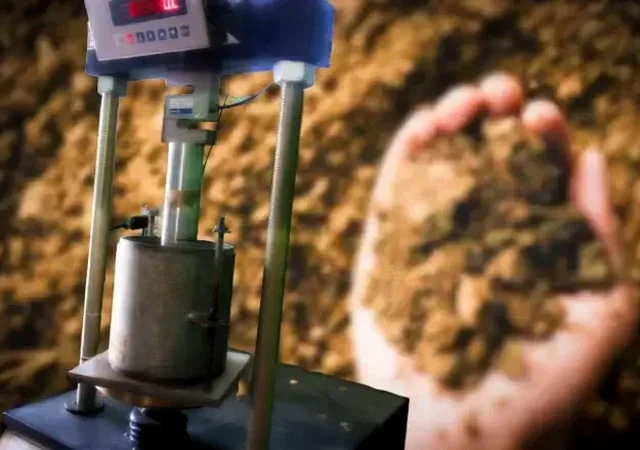
A lot of Spokane projects hit a wall when the subgrade turns to silt or volcanic ash. The decomposed basalt and Palouse loess around 47.65°N create a need for precise pavement thickness design. The laboratory CBR test gives you that direct bearing strength number, not an index. We run soaked CBR specimens in our lab to replicate the worst-case spring thaw conditions that plague the Inland Northwest. This is critical for county road upgrades and commercial parking lots in the Spokane Valley. Pairing soaked CBR values with a grain size analysis often reveals why some silts lose so much strength when wet. For deeper fill areas, many contractors also request sand cone density checks to verify compaction before we sample for CBR.
A soaked CBR value under 3% in Spokane’s silty subgrades signals a need for stabilization or removal—paving over it guarantees spring failure.
How we work
Local ground factors
Spokane’s freeze-thaw cycles are aggressive. The ground freezes hard in January when lows average 23°F, then saturates during the March snowmelt. A CBR test without proper soaking misses this critical failure window. We’ve seen unsoaked CBR values of 15% plummet to 2% after a 96-hour soak in silty soils from the Five Mile Prairie area. That difference means a pavement that rutts in the first spring instead of lasting 20 years. Another risk is oversampling disturbed material. If the lab mold doesn’t replicate field density and moisture, the result is useless. We insist on modified Proctor data alongside every CBR submission to ensure the compaction curve matches the target. Skipping the swell measurement is a mistake here—expansive characteristics in the local Latah Formation silts can heave a lightly loaded pavement.
Applicable standards
ASTM D1883: Standard Test Method for California Bearing Ratio (CBR) of Laboratory-Compacted Soils, AASHTO T 193: The California Bearing Ratio, WSDOT Standard Specifications Section 2-03.3, ASTM D698 / D1557 for moisture-density relations
Associated technical services
Soaked CBR Testing
Standard 96-hour immersion under surcharge. Measures bearing value and swell potential for WSDOT pavement design.
Compaction Curve Support
We run the Proctor test first to establish the target moisture and density before compacting the CBR molds.
Swell Analysis
Daily height readings track expansion during soak. Critical for identifying the Latah Formation’s expansive silts.
Design CBR Reporting
A single soaked design value at the specified compaction percentage, ready for your AASHTO pavement thickness calculation.
Typical parameters
Quick answers
What does a laboratory CBR test cost in Spokane?
For a standard three-point soaked CBR test in our Spokane lab, budget between US$110 and US$240 per sample. The range depends on whether we need to run the Proctor compaction curve first, or if you provide that data.
Why is the soaked CBR value more important than unsoaked?
Spokane’s subgrade moisture spikes in spring. The soaked test simulates that worst-case condition. An unsoaked CBR might look great for construction in August but fails to predict the severe strength loss when the silts get wet in March.
How much soil do you need for a CBR test?
We need about 50 pounds of disturbed, bagged soil. That gives us enough material to run the Proctor and compact three CBR molds. The sample must be representative of the subgrade you plan to pave over.
How long does the CBR test take?
The lab process takes about one week. That includes compaction, a mandatory 96-hour soak period, and the penetration test. We can expedite reporting if you need the design value quickly for a project deadline.