Spokane's foundation story is written in the aftermath of the great Missoula floods. The Rathdrum Prairie aquifer and the thick sequences of glacial till and outburst flood deposits that underpin downtown and the South Hill create a subsurface profile that demands more than a simple bearing capacity check. In our work across the Lilac City, from the historic Davenport district to the newer developments north of the Spokane River, we consistently see that the drained and undrained behavior of these silty sands and gravels can make or break a deep excavation design. A standard direct shear test often misses the pore pressure response that governs failure in these dense, overconsolidated deposits. That's where a properly executed triaxial test becomes essential. We run consolidated-undrained (CU) and consolidated-drained (CD) stages to isolate the effective stress envelope, giving structural engineers the real friction angle and cohesion intercept needed for a safe, cost-effective foundation. For sites near the river where loose alluvium is present, we often pair this with liquefaction triggering analysis to cover all seismic bases.
In Spokane's overconsolidated tills, the effective cohesion intercept is often lost when saturation isn't perfect—back-pressure saturation isn't a luxury, it's the difference between a safe design and a failure.
How we work
Local ground factors
The International Building Code (IBC) adopted by the City of Spokane mandates a site-specific geotechnical investigation for all structures classified as Risk Category III or IV. In our practice, we see too many project delays stemming from an over-reliance on correlated strength values from SPT blow counts. The Latah Formation and the interbedded flood deposits under Spokane's North Bank are notoriously heterogeneous; a five-foot shift laterally can mean the difference between a dense gravel with a friction angle of 40 degrees and a silty clay with a friction angle of 24 degrees. Using an unverified soil strength model in a slope stability analysis for a South Hill residence is a direct path to a retaining wall failure. We've reviewed forensic cases where the design assumed drained strengths that simply weren't there, leading to progressive creep and eventual collapse. The risk is amplified in Spokane's seismic setting—the city sits in a moderate seismicity zone, and the cyclic loading on saturated silts triggers undrained behavior. Without a proper triaxial shear test to define the undrained shear strength ratio, you're guessing on the factor of safety against bearing capacity failure during an earthquake.
Applicable standards
ASTM D4767 – Standard Test Method for Consolidated Undrained Triaxial Compression Test, ASTM D7181 – Standard Test Method for Consolidated Drained Triaxial Compression Test, IBC 2024 (adopted by City of Spokane) – Section 1803 Geotechnical Investigations, ASCE 7-22 – Minimum Design Loads for Buildings and Other Structures
Associated technical services
Consolidated-Undrained (CU) with Pore Pressure
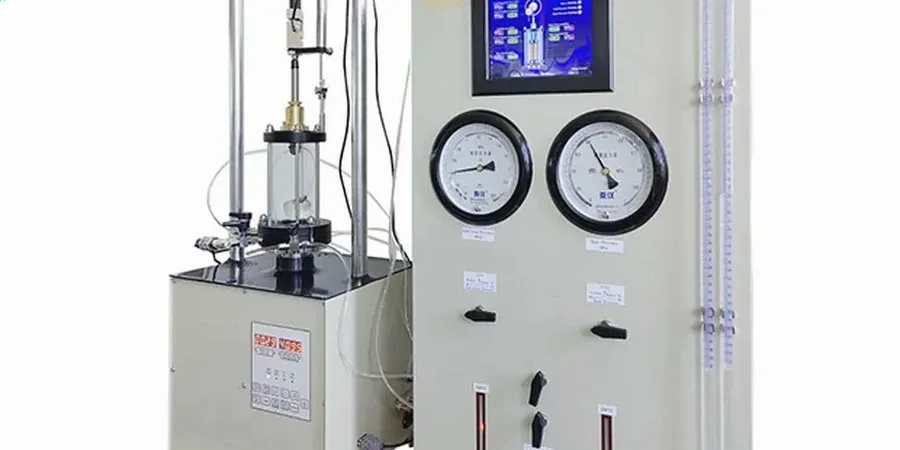
We run three-point CU triaxial tests on undisturbed samples from Spokane's glacial lake deposits to determine the effective stress friction angle and cohesion. This is the standard for evaluating long-term drained stability and short-term undrained strength during construction.
Unconsolidated-Undrained (UU) for Emergency Analysis
For rapid assessment of fine-grained soils under the Spokane Valley floor, we perform UU tests to quickly establish undrained shear strength (Su) when time constraints or budget limits prohibit full CU testing, while always advising on the conservative assumptions required.
Typical parameters
Quick answers
What is the typical cost for a triaxial shear test in Spokane?
A standard three-specimen triaxial test (CU with pore pressure measurement) in our Spokane lab generally runs between US$1,950 and US$3,020, depending on the soil type and the required saturation protocol. Dense tills and sandy silts from the Rathdrum Prairie require longer back-pressure saturation stages, which influences the final cost.
How long does a triaxial test take to complete?
From specimen preparation to final report, a standard CU triaxial test on Spokane's silty soils typically takes 5 to 7 business days. The consolidation phase alone can take 24 to 48 hours for the low-permeability silts of the Latah Formation, and we won't rush the shear rate because drained conditions must be maintained.
Can you test the coarse gravels common in Spokane's glacial deposits?
We can test soils with particle sizes up to 1/6th of the specimen diameter, which for our 2.8-inch samples means about a half-inch gravel. For the cleaner cobble gravels found in the Missoula flood bars, we typically recommend a large-scale direct shear test or reconstitute the sample with a scalped gradation, though we always discuss the limitations this imposes on the interpretation.
Why do you need pore pressure measurement for Spokane's soils?
Because the dense, overconsolidated tills and silts under Spokane tend to dilate during shear, generating negative pore pressures that temporarily increase strength. If you don't measure this, you'll overestimate the drained friction angle. We track pore pressure with electronic transducers to separate true frictional resistance from suction effects, giving you a reliable effective stress envelope for long-term stability analysis.