Spokane's topography tells a geologic story that directly shapes modern construction. The city's growth from a frontier trading post at Spokane Falls into a regional hub pushed development onto terraces carved by Ice Age floods and into hillsides blanketed with wind-deposited loess. These soils behave differently under load than the dense basalt bedrock that underlies much of the valley. A retaining wall here isn’t just a landscape feature—it’s a structural element managing lateral earth pressures from silty soils that can lose strength when saturated. The South Hill neighborhood, with its steep slopes and panoramic views, presents classic challenges where proper retaining wall design is essential before any excavation begins. Builders working near the Spokane River or along Latah Creek encounter groundwater and alluvial deposits that demand thorough subsurface investigation. Getting the wall right means matching the design to the specific soil profile, not copying a generic detail from a different climate. We routinely pair retaining wall design with slope stability analysis on sites where the wall supports a cut into existing grade, ensuring global stability isn’t compromised.
Spokane's silty loess soils can lose over half their strength when saturated—drainage design isn't optional, it's the primary defense against wall failure.
How we work
Local ground factors
Two sites five miles apart in Spokane can present completely different retaining wall design requirements. A lot on the South Hill perched above the Palouse formation might sit on stiff, overconsolidated silts with good drained strength—until you excavate and expose them to winter moisture. Meanwhile, a commercial site in the Spokane Valley, closer to the aquifer recharge zone, often deals with coarse alluvium and groundwater within six feet of the surface. The South Hill wall fails gradually if drainage is neglected; the Valley wall can experience rapid loss of bearing capacity if water isn’t controlled during construction. Frost heave is an underappreciated risk in both settings. Silty soils are highly frost-susceptible, and a wall footing placed above the frost line can lift unevenly, cracking the stem and compromising the entire structure. Poor compaction behind MSE walls leads to settlement of the reinforced zone, creating a visible dip behind the wall face. These aren’t hypothetical scenarios—they’re patterns we’ve observed in forensic evaluations around the county. The cost of rebuilding a failed wall routinely exceeds the original construction budget by a factor of two or three, not counting landscape restoration.
Applicable standards
IBC 2021 (adopted by City of Spokane with local amendments), ASCE 7-22 Minimum Design Loads for Buildings and Other Structures, ASTM D2487 Standard Practice for Classification of Soils, AASHTO LRFD Bridge Design Specifications (for MSE walls in ROW), NCMA Design Manual for Segmental Retaining Walls
Associated technical services
Site investigation and soil characterization
We log test pits or oversee SPT borings to define stratigraphy, collect samples for lab testing, and measure groundwater depth—critical for wall type selection and drainage design.
Structural design and calculations
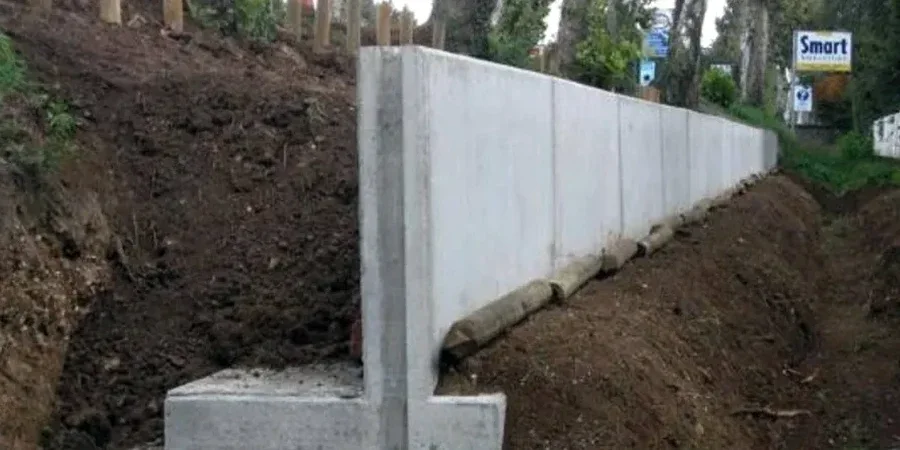
Reinforced concrete cantilever walls, gravity block walls, and MSE systems are designed to resist sliding, overturning, and bearing capacity failure under Spokane's soil and seismic conditions.
Drainage system design
Every wall design includes a drainage plan specifying filter fabric, granular chimney drains, weep hole spacing, and toe drain connections to daylight or storm sewer.
Construction observation and verification
We inspect backfill placement, compaction testing, reinforcement layout, and drainage installation to confirm the as-built wall matches the design intent and code requirements.
Typical parameters
Quick answers
What does a retaining wall design typically cost in Spokane?
For a typical residential or light commercial retaining wall in the Spokane area, design fees range from US$1.160 to US$3.740 depending on wall height, complexity, surcharge loading, and whether global slope stability analysis is required. Taller walls over 6 feet, those supporting structures, or walls in difficult access sites fall toward the upper end.
Do I need a permit for a retaining wall in Spokane?
Yes, the City of Spokane requires a building permit for retaining walls over 4 feet in height measured from the bottom of the footing to the top of the wall. Walls supporting a surcharge (like a driveway or structure) require engineering regardless of height. Spokane County has similar thresholds.
What is the biggest cause of retaining wall failure here?
Inadequate drainage is the number one cause we see in Spokane. Water trapped behind the wall builds hydrostatic pressure, dramatically increasing the lateral load. Combined with freeze-thaw cycling in our silty soils, poor drainage leads to bulging, cracking, and eventual collapse—often within the first five winters.
How long does the design process take?
A typical retaining wall design takes two to three weeks from authorization, assuming soil data is already available. If subsurface investigation is needed, add one to two weeks for field work and lab testing. Complex walls with global stability analysis or MSE design may require three to four weeks.