Spokane's growth from a railroad hub to a modern inland Northwest city left a legacy of infrastructure that now requires expansion beneath challenging ground. The Spokane Valley-Rathdrum Prairie aquifer underlies much of the metro area, with coarse fluvial deposits overlying fine-grained lacustrine silts and clays—a profile that creates real headaches for tunneling. At our materials lab, we focus on the geotechnical analysis for soft soil tunnels that contractors and agencies need before mobilizing a TBM or beginning sequential excavation. Our team works routinely with the soft ground tunneling specifications required by local transit and utility projects, and we bring ASTM D2487-compliant classification to every bore log. The basalt bedrock is deep in many corridors, meaning tunnel alignment stays within compressible soils where stand-up time is short and face stability demands precise engineering data.
Stand-up time in Spokane's glaciolacustrine silts can be measured in hours, not days. You need deformation moduli from lab tests, not just SPT N-values.
How we work
Local ground factors
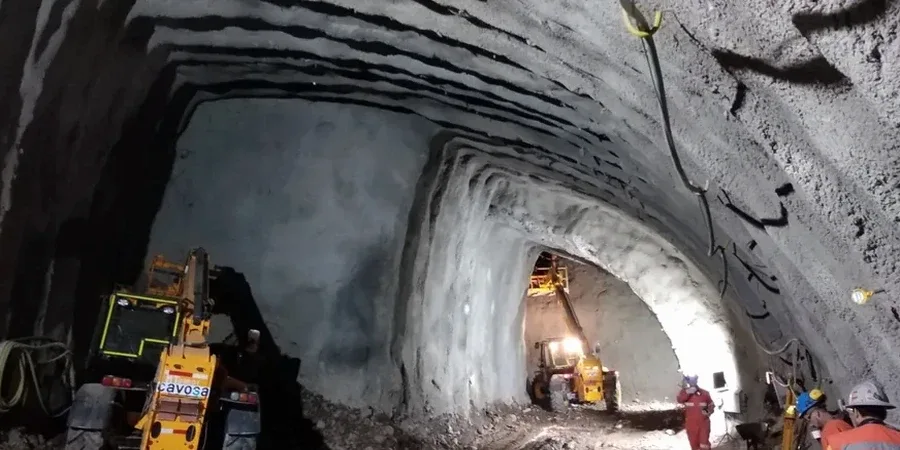
The contrast between South Hill's loess-covered basalt and the valley floor's saturated alluvium is stark. Up on the hill, you are dealing with stiff silts and rock—tunneling is a rock mechanics problem. Down in the valley, between Division Street and Havana, the same tunnel depth puts you in running ground with high pore pressures. The biggest risk we see in Spokane's soft soil tunneling is not just face collapse but also the potential for groundwater inflow triggering settlement of overlying structures. The granular lenses in the aquifer can transmit pressure drops hundreds of feet from the heading. We quantify this risk through steady-state seepage modeling and consolidation analysis, providing the input parameters for contractor pre-grouting programs or EPB machine selection. Our lab testing identifies the fines content and plasticity that dictate whether a soil will clog a cutterhead or flow freely.
Applicable standards
ASTM D2487 (Unified Soil Classification System), ASTM D4767 (Consolidated Undrained Triaxial Test), IBC Chapter 18 (Soils and Foundations), ASCE 7-22 (Minimum Design Loads), ASTM D2435 (One-Dimensional Consolidation), ASTM D5084 (Flexible Wall Permeability)
Associated technical services
Advanced Laboratory Testing for Tunneling
CU and UU triaxial tests, oedometer consolidation, and constant-head permeability testing on undisturbed Shelby tube samples. We deliver effective stress parameters, compression indices, and k-values for ground loss and settlement predictions.
Ground Improvement Verification
Pre- and post-treatment testing for grouting, jet grouting, or ground freezing programs. Includes strength testing of treated soil cores and permeability verification to confirm cutoff performance.
Construction Phase Monitoring Support
We provide baseline data and ongoing lab correlation for convergence monitoring, surface settlement arrays, and piezometer readings. Our team helps distinguish between normal deformation and developing instability.
Typical parameters
Quick answers
What lab tests are mandatory for a soft soil tunnel in Spokane?
At minimum, we recommend classification testing (ASTM D2487), undrained shear strength via UU or CU triaxial (ASTM D4767), and one-dimensional consolidation (ASTM D2435) to define compressibility. For tunnels below the water table, permeability testing (ASTM D5084) is essential for dewatering design. Projects using EPB machines also benefit from Atterberg limits and grain size distribution to assess soil conditioning requirements.
How do you handle sampling in Spokane's gravelly interbeds?
The coarse fluvial deposits are tough to sample with conventional Shelby tubes. We use pitcher barrel samplers or sonic coring to recover representative material, then reconstruct gradation curves in the lab. For the finer matrix within the gravels, we still perform classification and strength tests on the recovered fines fraction to bound the behavior.
What's the typical cost range for a tunnel geotechnical investigation?
For a soft soil tunnel project in the Spokane area, laboratory testing and analysis packages typically range from US$3,960 for a limited scope investigation to US$15,010 for a comprehensive program with multiple boreholes, advanced triaxial testing, and consolidation analysis. The final cost depends on borehole depth, number of samples, and the specific testing protocol required.
Can you model consolidation settlement from our tunnel?
Yes. We provide the primary and secondary compression parameters (Cc, Cα) needed for analytical or numerical models. Our reports include e-log p curves and preconsolidation pressure estimates so your team can run settlement predictions in PLAXIS or FLAC using lab-measured, not assumed, compressibility.
How quickly can you turn around lab results?
Classification and index tests can be completed within 3-5 business days. Consolidation tests require 7-10 days due to incremental loading. Triaxial testing typically takes 10-14 days. We coordinate scheduling with your drilling program so that critical parameters are available when the design team needs them.