Spokane's development east of the Cascades brought rail yards, warehouses, and now infill housing onto the flood-deposited silts of the Spokane Valley aquifer. Those soils, underlain by Miocene basalt at variable depth, create a foundation environment where differential settlement can appear within a single building footprint. We apply raft/mat foundation design when column loads are heavy, bearing soils are marginal, or the water table sits within the basement depth. A mat distributes structural load across the entire plan area, so localized soft spots don't translate into cracked shear walls. In downtown Spokane, where the 1908 Great Fire reset building stock, many newer structures rely on mat foundations to bridge the transition between the coarse terrace gravels near the river and the finer alluvium farther south. When the geotechnical report flags liquefiable lenses in the Spokane Valley, we often combine the mat design with a liquefaction assessment to verify post-shaking bearing capacity before sizing the slab.
A properly designed mat foundation turns Spokane's erratic floodplain soils into a single load-sharing platform—no isolated footings, fewer surprises.
How we work
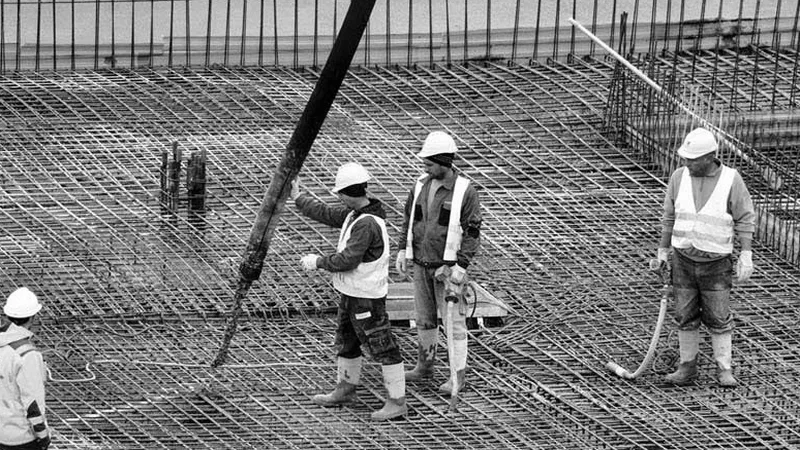
Local ground factors
East of the Cascades, Spokane gets 45 inches of snow annually, yet summer wildfire season bakes the surface silts into hydrophobic crusts. That freeze-thaw-and-dry cycle drives volume change in the upper 3 to 5 feet, and a mat foundation must either extend below that active zone or be designed for the resulting cyclic soil pressures. We also contend with the Spokane-Rathdrum Prairie Aquifer, one of the most productive in the country, which sits just 20 to 40 feet below the surface across much of the valley. A high water table during spring melt raises buoyancy forces on the mat, requiring a check for flotation and, in some cases, a thickened slab or under-slab drainage layer. Seismic demand from the North American Plate boundary adds another layer: ASCE 7-22 site class D or E soils can amplify ground motion, and the mat must be detailed to transfer base shear into the lateral force-resisting system without cracking at the cold joint between mat and shear wall.
Applicable standards
IBC 2024 (International Building Code), ASCE 7-22 Minimum Design Loads, ACI 318-19 Building Code for Structural Concrete, ASTM D1194 Standard Test Method for Bearing Capacity of Soil for Static Load, ASTM D2487 Classification of Soils for Engineering Purposes
Associated technical services
Geotechnical Investigation for Mat Design
We execute SPT borings, plate load tests, and laboratory consolidation testing to build a layered subgrade model. The output is a design report with modulus of subgrade reaction, allowable bearing pressure, and settlement predictions tailored to the specific footprint geometry. For sites near the Spokane River or Latah Creek, we include liquefaction screening per ASCE 7 and, where needed, post-liquefaction settlement analysis.
Structural Mat Design and Detailing
Using the geotechnical parameters, we model the mat in finite element software to capture stress concentrations under columns and walls. We deliver reinforcement plans, grade beam sections, and construction joint layouts that comply with ACI 318 and local Spokane County building requirements. The package includes shear and flexure checks, punching shear verification at concentrated loads, and frost protection details for unheated building areas.
Typical parameters
Quick answers
What is the typical cost for a raft/mat foundation design in Spokane?
For a single-family residential or light commercial project in Spokane, the combined geotechnical investigation and structural mat design typically falls between US$1,010 and US$4,420, depending on the footprint size, number of borings required, and complexity of the soil profile. A larger custom home with a walk-out basement on a sloping South Hill lot will be at the upper end due to additional retaining wall and drainage coordination.
When is a mat foundation better than isolated footings in Spokane soils?
A mat makes sense when the allowable bearing pressure is below about 2,000 psf, when footing sizes exceed half the building footprint, or when the soil profile varies enough that differential settlement between isolated footings would exceed the L/500 limit. In Spokane Valley, where floodplain silts and liquefiable lenses exist, a mat also provides redundancy that isolated footings cannot.
How do you handle the high groundwater table in the Spokane Valley for mat design?
We check flotation using the worst-case seasonal high groundwater level, applying a factor of safety of 1.2 against uplift per ASCE 7. If the mat alone doesn't provide enough dead load, we specify a thickened slab, under-slab drainage connected to a sump, or a perimeter drain to lower the phreatic surface below the mat invert.
Do you coordinate with the structural engineer of record?
Yes. We typically work as the geotechnical consultant to the structural engineer, providing the subgrade model, allowable bearing values, and settlement curves. If the project needs full mat detailing, our structural team can produce the reinforcement drawings under one contract, reducing coordination gaps and RFI cycles during construction.